Top Precision Fluid Component Connector Manufacturers for Medical, Biopharma, Dental and more!
Top Precision Fluid Component Connector Manufacturers for Medical, Biopharma, Dental and more!
Hospitals don’t mess around with sterilization. When healthcare-associated infections are a constant threat, clinical teams run non-stop disinfection protocols around the clock. Every surface, line, and connector gets hit with strong chemical agents like high-concentration isopropyl alcohol, quaternary ammonium compounds, hydrogen peroxide solutions,and even harsh lipid solutions. It’s necessary. It’s also hard on plastic.
The problem is that the same chemicals keeping patients safe can quietly destroy the fluid path components that keep those patients alive. And the damage isn’t a gradual thing, it can be sudden.
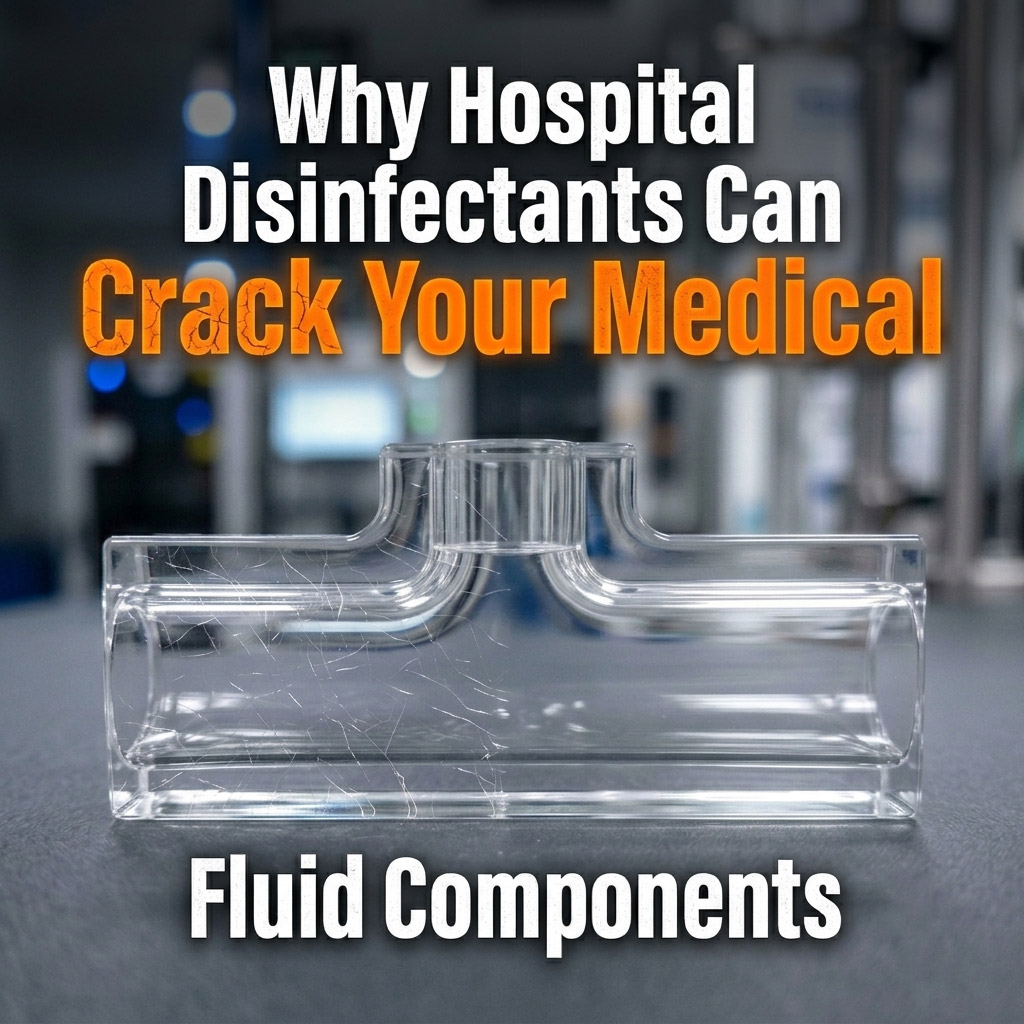
The technical name is Environmental Stress Cracking, or ESC. It sounds complicated, but the basic idea is really straightforward: when a plastic component is under tension and gets exposed to certain chemicals at the same time, it can crack in a way that simple chemical exposure or simple mechanical stress alone would cause it to. The two things together create a failure that neither would create on its own.
Here’s how it plays out. The disinfectant molecules work their way into the tiny spaces between the polymer chains that make up the plastic. This then softens the material from the inside, almost like a slow-acting plasticizer. And then at the same time, the component is under some form of tensile stress, like from a tight luer connection, internal fluid pressure, or stress built into the part during manufacturing. That combination then starts separating the polymer chains at a microscopic level and can create tiny voids inside the material.
Those micro-voids are called crazes. If left alone, they grow and connect. Eventually, you don’t have a network of tiny voids anymore, you have actual cracks. And because the failure is happening inside the material the whole time, you often don’t see it coming until a connection leaks, a line depressurizes, or a component fails outright. In a clinical fluid path, this becomes a real patient safety issue.
Not all medical-grade plastics handle chemical exposure the same way. Semi-crystalline resins are naturally resistant to ESC because their tightly packed molecular structure gives chemicals less room to work their way in. The downside is that they’re not clear, and for blood-contacting lines or applications where clinicians need to visually track bubbles, transparency isn’t optional.
That leaves amorphous thermoplastics, which offer full optical clarity but are historically more vulnerable to stress cracking. The solution isn’t to pick one property and sacrifice the other. It’s to use high-performance medical-grade materials that are engineered to close that gap.
Brevet works with amorphous thermoplastics like Covestro Makrolon Rx2530, a premium medical polycarbonate with an exceptionally high molecular weight. The denser molecular structure slows chemical diffusion significantly, which gives the material much better resistance to crazing without giving up the optical clarity that clinical applications require. It’s not a perfect tradeoff-free material, but for the applications it’s designed for, it’s about as close as the industry currently gets.
Here’s something that often gets overlooked: a well-chosen material can still fail from ESC if the part itself carries residual stress from the manufacturing process. Injection molding introduces internal stress into a component every time, and if the cooling profile, gate geometry, or injection pressure isn’t controlled right, that residual stress can act like a permanent internal tension load on it. The part ships already primed to crack.
Brevet addresses this at the tooling level. Gate geometries and runner paths are engineered to fill the mold cavity as evenly as possible, which keeps localized shear stress from building up in one spot. Multi-zone temperature control during cooling ensures the polymer solidifies uniformly rather than cooling fast on the outside and slow in the middle, which is one of the most common sources of residual stress. And sharp internal corners, which concentrate mechanical load at a point rather than distributing it across a surface, are replaced with radiused features wherever the geometry allows it.
The result is a component that enters clinical use with the lowest possible baseline stress, which means it takes a lot longer for chemical exposure to work its way towards a failure.
If you’re designing a medical fluid path that will live in a hospital or clinical environment, ESC isn’t a hypothetical thing. It’s a real failure mode with real consequences. The decisions that determine whether your components resist it happens early, in material selection, in tooling design, and in the processing parameters.
Getting those decisions right is exactly what Brevet is here to help with.
