Top Precision Fluid Component Connector Manufacturers for Medical, Biopharma, Dental and more!
Top Precision Fluid Component Connector Manufacturers for Medical, Biopharma, Dental and more!
Picture medical device sterilization and you probably imagine hours of chemical gas soaking, glowing radioactive chambers, or steam hot enough to cook dinner. Now meet Electron Beam (E-Beam) sterilization, the fast, modern alternative that uses pure electricity to wipe out bioburden in seconds flat.
For medical device innovators, E-Beam isn’t just another sterilization method on the list. It’s basically a logistics cheat code, one that keeps polymer-based fluid circuits clean without putting your production schedule through the wringer. And as more MedTech and biopharma teams push toward faster, leaner manufacturing, it’s becoming less of a niche alternative and more of a default choice.
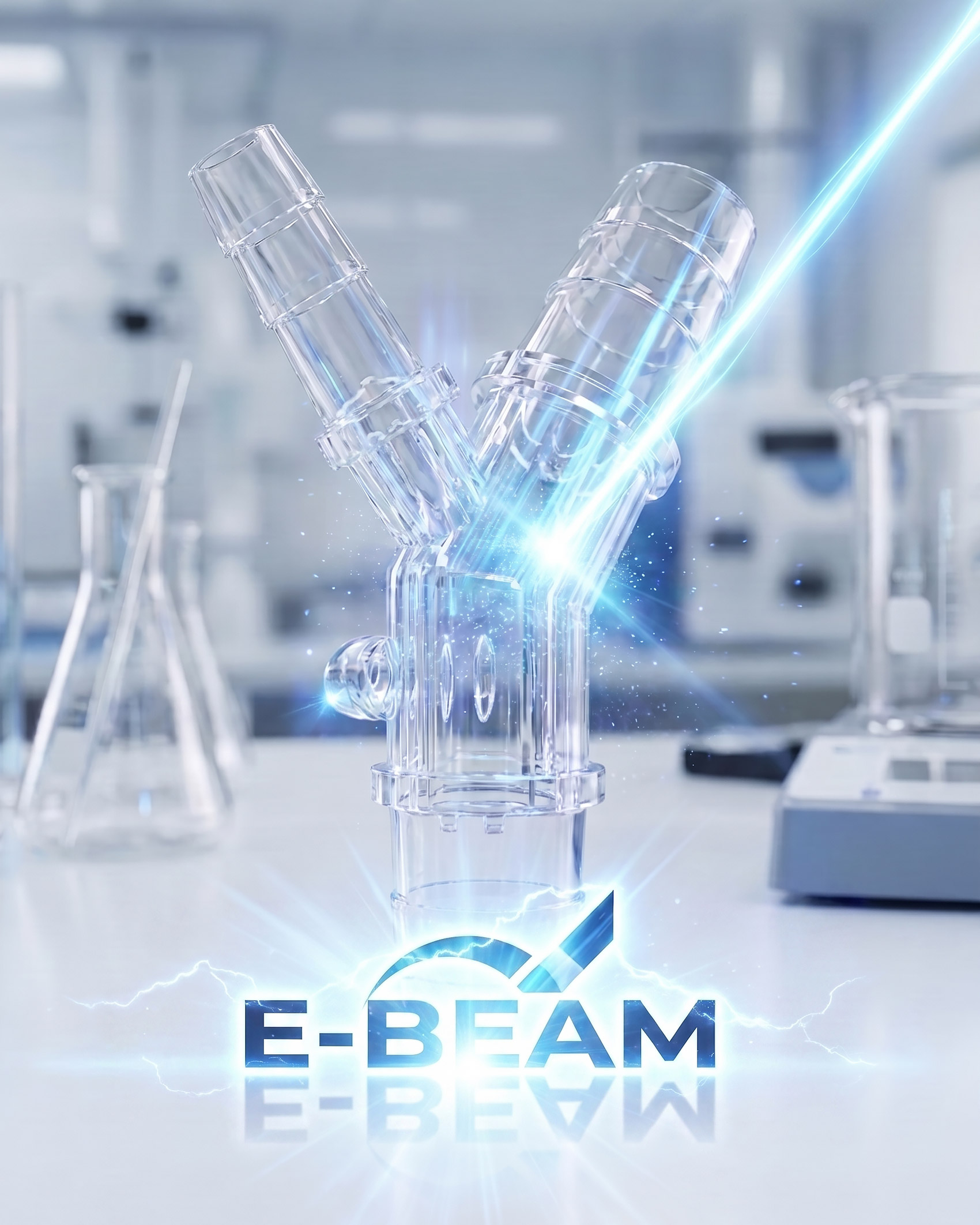
How It Works – It’s like totally Sci-Fi!
An E-Beam accelerator is, in essence, a mini particle accelerator. It pulls standard electricity from the grid, ramps a concentrated stream of electrons up to nearly the speed of light, then fires them straight at the target material.
When those electrons collide with microscopic pathogens, there’s no heat and no chemicals involved. They act more like a demolition crew, shattering the molecular bonds in bacterial and fungal DNA and RNA on contact. The organisms can no longer reproduce, and you’re left with a sterile component without any of the drama.
The other neat part is how controllable the process is. Because the dose is delivered electronically rather than through a slow chemical reaction or a decaying isotope, engineers can dial in dose levels with real precision. That kind of control matters when you’re sterilizing sensitive polymer geometries that can’t tolerate much variability.
Why Engineers and Logistics Teams Are All In on E-Beam
So why are manufacturers increasingly making the switch to electricity-driven sterilization? A few reasons stand out.
Speed That’s Almost Hard to Believe
Gamma radiation can take hours, and Ethylene Oxide (EtO) can take days once you factor in the mandatory gas aeration phase. E-Beam gets the job done in seconds as boxes roll down the conveyor belt. For manufacturers running tight production schedules, that difference alone can reshape how inventory and shipping timelines get planned.
Easier on the Materials
Because the dose is delivered so quickly, polymers see far less degradation, discoloration, or embrittlement than they would under prolonged Gamma exposure. Your flexible tubing stays flexible. Your polycarbonates stay clear. This matters even more on complex fluid path components, where a slightly stiffer polymer or a hint of discoloration can be the difference between a part that passes inspection and one that gets flagged.
Cleaner From an Environmental Standpoint
E-Beam runs entirely on electricity, so there’s no Cobalt-60 or other radioactive isotopes involved. Flip the machine off and the radiation is simply gone. No radioactive waste to manage, no toxic gas residue, no quarantine periods eating into your schedule. It also sidesteps the supply chain headaches that have periodically hit the Gamma industry, since Cobalt-60 sourcing has had its own well documented shortages over the years.
Ready to Ship the Moment It’s Sterile
E-Beam penetrates low-to-medium density components right through their final sealed packaging. Components come off the conveyor already sterile and ready to head straight to the clinical floor.
A Quick Side-by-Side
If you’re weighing E-Beam against the more traditional methods, here’s roughly how they stack up:
Not every component is a perfect fit for E-Beam, especially very dense materials or those sensitive to radiation dose, but for a large share of medical polymer applications, it’s quickly becoming the practical first choice.
Where This Fits at Brevet
At Brevet, we design our custom fluid hubs, single-use manifolds, and luer assemblies with this kind of high-speed radiation workflow in mind from day one. Matching the right polymer to technology like E-Beam is how we help you get to market faster without asking patient safety to take a back seat.
