Top Precision Fluid Component Connector Manufacturers for Medical, Biopharma, Dental and more!
Top Precision Fluid Component Connector Manufacturers for Medical, Biopharma, Dental and more!
Anyone paying attention to biopharma right now has probably noticed how fast the pace has picked up in it. Demand keeps climbing, timelines keep shrinking, and facilities are having to rethink how they operate just to keep from falling behind. One of the biggest shifts we’re seeing is the move away from heavy, permanent stainless-steel infrastructure and toward Single-Use Technologies, or SUTs.
If you’ve talked to any bioprocessing engineers or facility managers lately, you’ve probably heard the same word come up over and over: agility. That’s really what this shift comes down to. Let’s talk about why precision disposable plastic connectors are becoming the go-to choice for scaling up production.
If you’ve ever worked with permanent piping, you know the routine. Clean-in-Place and Sterilize-in-Place protocols eat up a lot of time, a lot of energy, and a lot of resources. There’s no way around it when you’re running fixed steel lines.
Single-use systems change that equation! Instead of shutting a line down for cleaning and revalidation, your team can just swap in a pre-sterilized, closed-system fluid pathway and keep moving. That plug-and-play setup saves money on cleaning chemicals and downtime, sure, but it also cuts down the risk of cross-contamination between batches in a meaningful way. And when you need to reconfigure a line quickly, disposable components let you do that without sinking a ton of capital into it.
Material integrity is everything when you’re talking about single-use systems. High-purity, medical-grade plastics like polycarbonate and flexible PVC are built to handle serious demands. They resist a wide range of chemicals, hold their shape under stress, and stand up to standard gamma irradiation for sterilization without breaking down.
At macro scale, what actually matters is performance and dimensional stability. You need connectors that give you leak-free, reliable flow at production-scale rates, day after day. Because these parts are built from durable plastics rather than glass, the priority isn’t optical clarity, it’s dependable engineering that holds up under real operating conditions. It’s about function first.
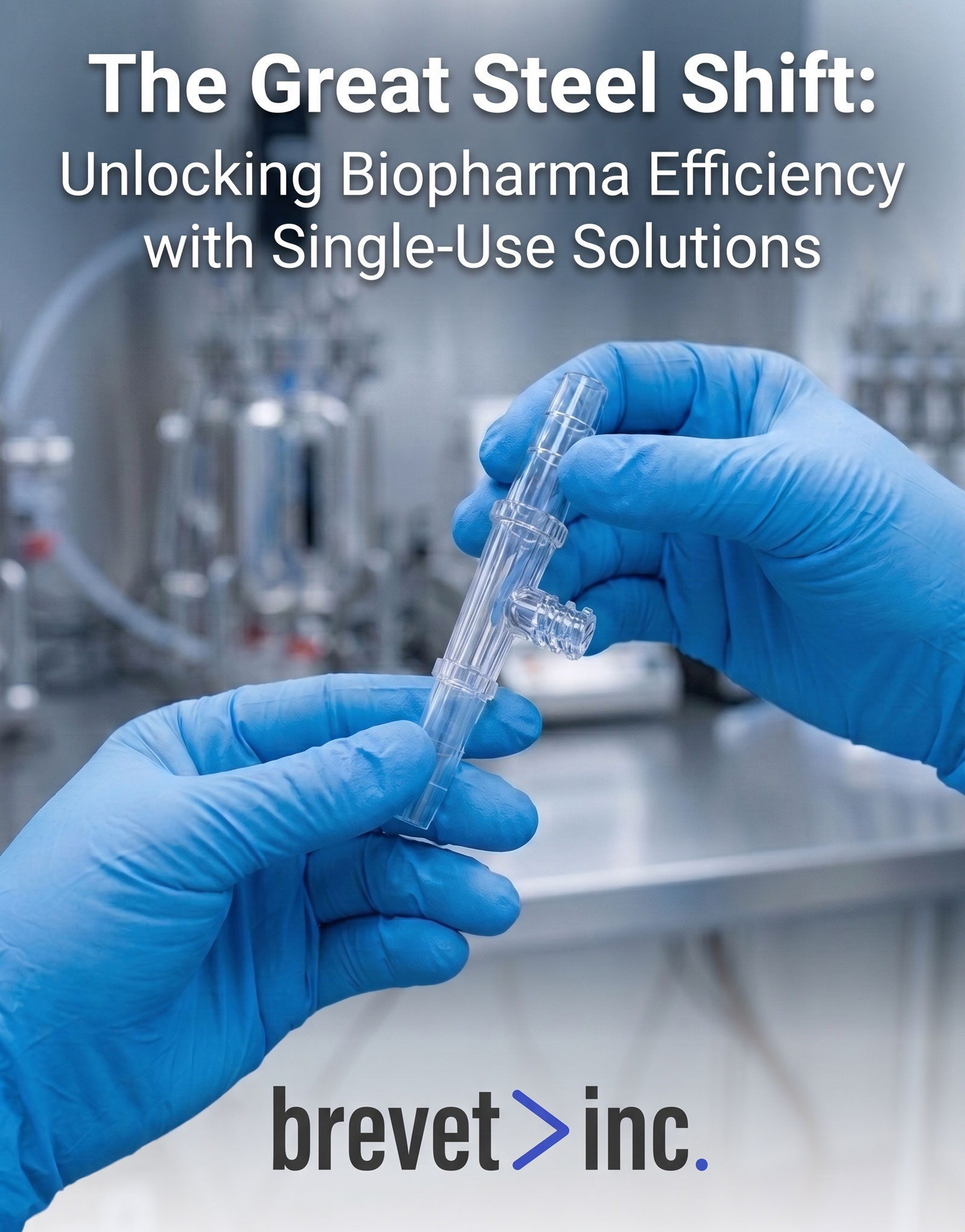
Every facility runs a little differently, which is why the right mix of standard and custom-manufactured components matters so much when you’re building out fluid pathways. A few of the components that tend to carry the most weight:
Getting these components right, and matching them to your actual process parameters, is what keeps fluid routing smooth instead of becoming its own bottleneck.
Switching to single-use fluid routing isn’t just a trend, it’s a practical move toward a faster, safer, and more adaptable facility. Trading permanent steel for high-quality plastic pathways can help products get to market faster while keeping day-to-day operations running smoothly.
If your facility is looking to streamline fluid management, custom-manufactured Y-connectors, T-connectors, and reducers built around your specific setup can make a real difference in how things flow.
