Top Precision Fluid Component Connector Manufacturers for Medical, Biopharma, Dental and more!
Top Precision Fluid Component Connector Manufacturers for Medical, Biopharma, Dental and more!
When you’re sourcing custom fluid handling components, whether it be a high-stakes biopharma manifold or continuous-flow data center cooling, it’s easy to get laser focused on the polymer properties. The ultimate performance, clarity and seal integrity of any molded part gets locked in way before resin ever hits the barrel. It all comes down to the heavy, hardened steel tooling behind it!
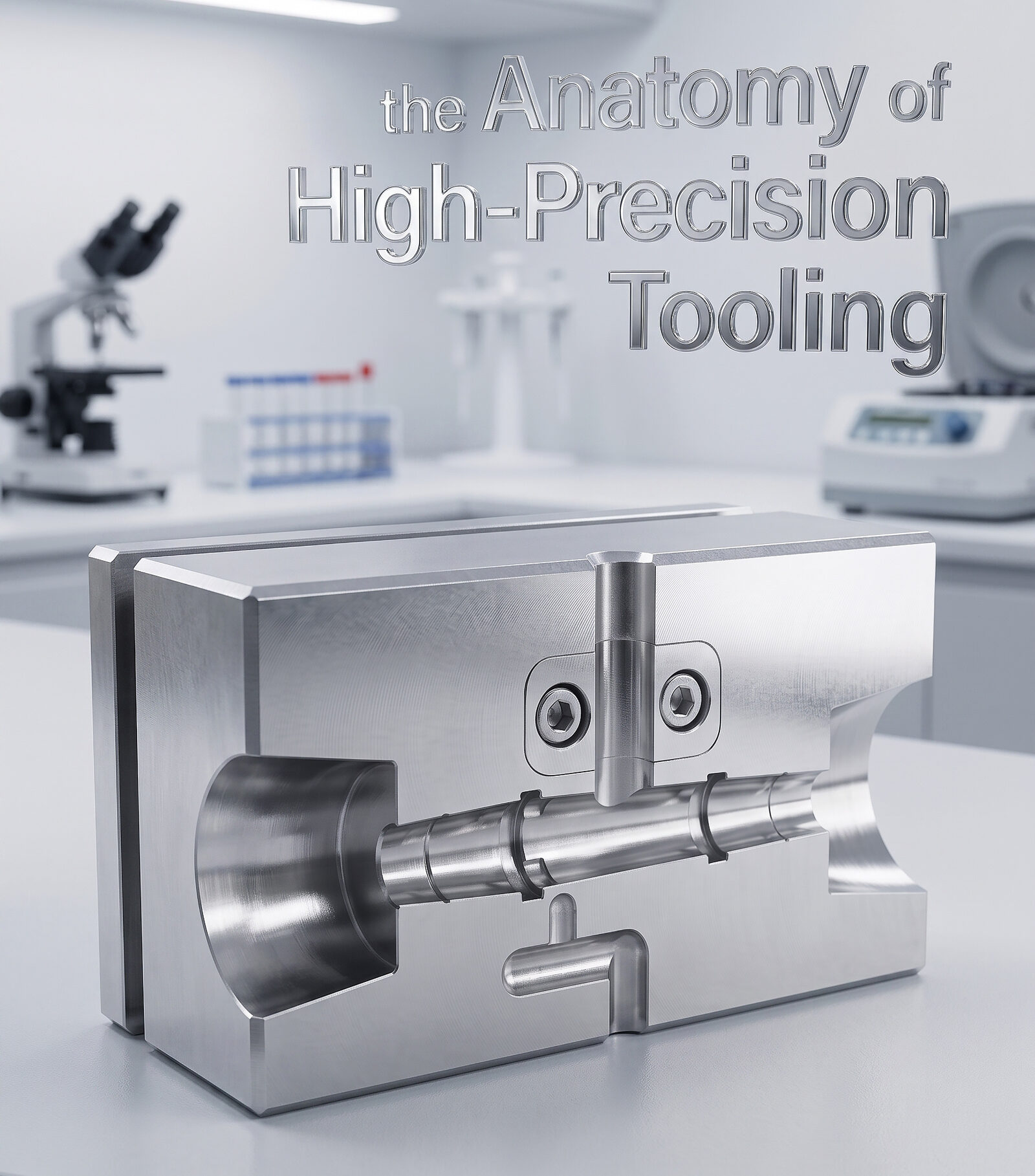
To the untrained eye, a mold tool just looks like a massive, impenetrable block of metal. But to a precision moldmaker, it’s really a micro-engineered canvas where sub-micron accuracy decides whether a component holds up in the field or fails.
The Physics of Heavy Steel and Why the Mass Matters
Injecting high-performance thermoplastics like amorphous polycarbonates takes serious hydraulic pressure. Light-duty or prototype tooling can experience microscopic deflection under those extreme forces, something in the industry known as mold flex.
Even a mold flexing a fraction of a millimeter is enough for molten plastic to seep between the parting lines and create what’s called flash. In medical catheters, a flash ridge just 5 microns tall can snag a guidewire. In data center liquid cooling, it can compromise O-ring seals and set off catastrophic leaks. That’s why heavy-gauge tool steel matters so much. It gives you the structural rigidity to withstand multi-ton clamping forces without yielding even a single micron.
The Machining Breakdown: CNC Milling vs. Wire EDM
Turning a solid 200-pound steel block into a mirror-finish internal cavity takes a multi-stage machining process:
✅ High-speed CNC roughing: heavy CNC mills carve out the primary geometry of the mold base and main fluid channels.
✅ Electrical discharge machining (EDM): for the intricate stuff, sharp-radius features, deep internal ports, smooth Y-junctions, wire and sinker EDM use high-frequency electrical sparks to erode the hardened steel with extreme sub-micron precision.
✅ Core-pin alignment: precision-ground steel core pins define the internal bore of the fluid paths. Keeping perfect concentricity across these pins is what guarantees zero internal ridges and the best possible fluid dynamics.
✅ Optical polishing: cavity walls get hand-polished or optically polished to a mirror finish, so you get crystal-clear transparency for visual bubble tracking out in the field.
Each of these stages builds on the last. Skip a step, rush the polish, or use a steel that’s not suited to the resin, and the shortcuts always show up downstream, usually right when a customer is depending on the part most.
Why This All Comes Back to the Steel
It’s worth repeating that none of the downstream performance, clarity, seal integrity, the tight tolerances, is even possible without getting the tooling foundation right first. A perfectly formulated resin poured into a mold with the wrong steel, the wrong hardness, or a flex-prone design will still produce a flawed part! The tool is where the real engineering happens, long before the first shot of plastic ever gets injected.
Quality You Can Measure
Investing in hardened, high-precision steel tooling is what gets you multi-million-cycle repeatability. Every part coming off the line matches the exact dimensions of the very first one, which means:
✅ Zero-defect manufacturing across production runs
✅ Seamless automated assembly downstream
✅ Verified dimensional consistency for regulatory documentation
✅ Real peace of mind for high-compliance applications
At Brevet, we design and build precision tooling made to handle the highest injection pressures without compromising internal geometry or surface finish. From alloy selection to final polish, every decision in the tool room is made with the end application in mind, whether that’s a biopharma manifold or a mission-critical cooling system.
