Top Precision Fluid Component Connector Manufacturers for Medical, Biopharma, Dental and more!
Top Precision Fluid Component Connector Manufacturers for Medical, Biopharma, Dental and more!
What engineers actually need to know before specifying PC in a fluid path
When it comes to fluid handling, seeing what’s happening inside the line matters. Whether you’re confirming a bubble-free delivery in a biopharma manifold, keeping an eye on coolant in a dense server loop, or routing media through a high-throughput food and beverage line, polycarbonate keeps showing up as the material of choice. It gives you glass-like clarity, serious impact resistance, and the kind of structural rigidity that softer plastics just can’t offer.
That being said, polycarbonate has its own personality when chemistry gets involved. It’s an amorphous polymer, which means its molecular chains can be sensitive to certain solvents, strong bases, and localized stress. Brevet reduces molded in stress thru annealing and testing all products at an outside accredited laboratory. If you want to get the most out of your fluid pathways, it helps to know where polycarbonate performs beautifully, where you need to slow down and think, and how good manufacturing keeps everything running safely.
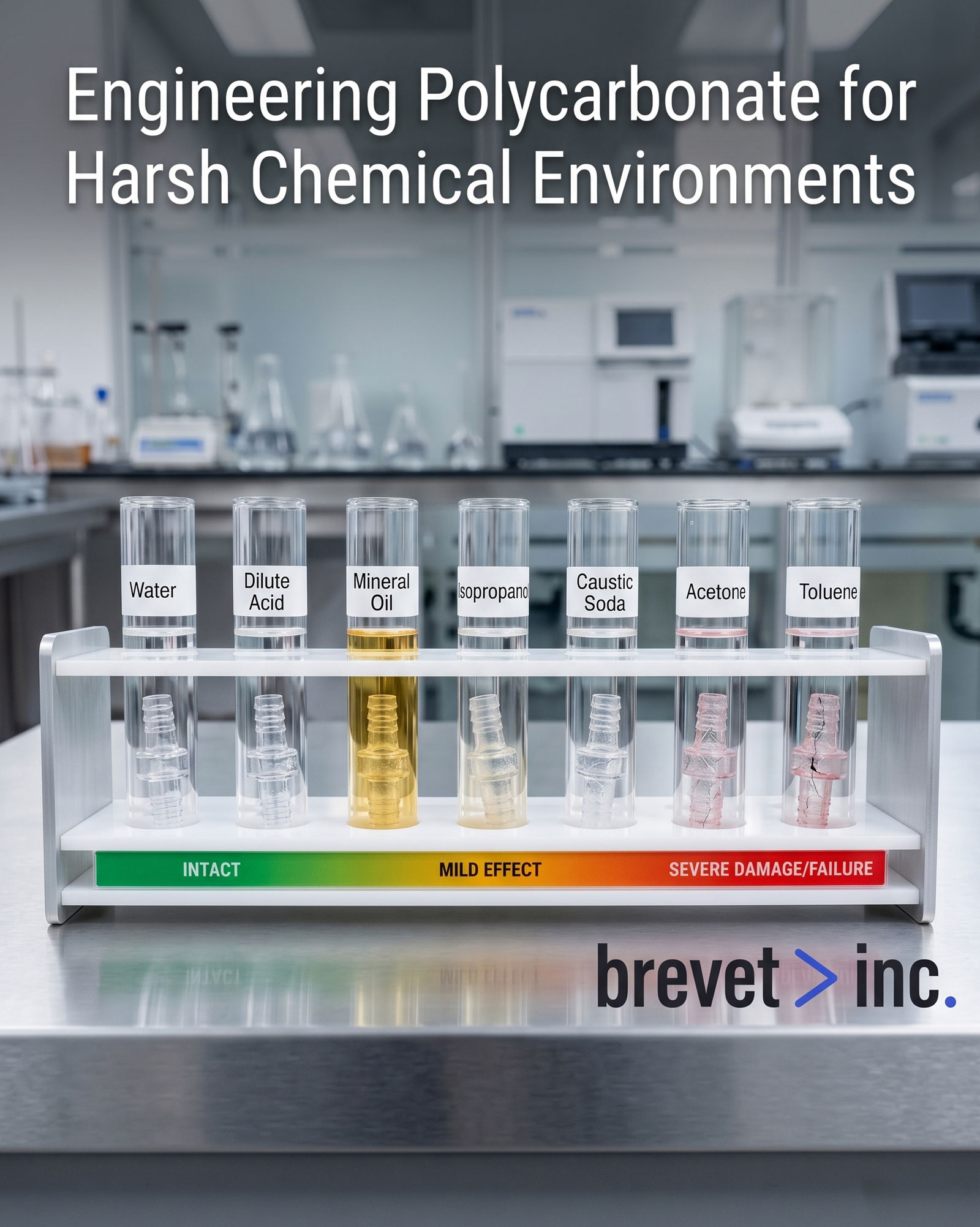
Where Polycarbonate Holds Up (and Where It Doesn’t)
Chemical resistance is never a flat yes or no answer. It depends on concentration, temperature, how long the exposure lasts, and how much pressure is running through the line. Here’s a general sense of how PC handles common fluids:
The Real Culprit Behind Most Failures
Here’s something that surprises a lot of people. When a polycarbonate fitting fails out in the field, it’s usually not because a chemical simply dissolved it. The more common issue is something called environmental stress cracking, or ESC.
ESC happens when chemical exposure and mechanical stress team up. A fitting might sit fine on a lab bench soaking in a mild fluid all day. But put that same fitting under mechanical load, like the hoop stress created when flexible tubing gets stretched over a barbed connector, and the chemical exposure can turn tiny microscopic crazes into real structural cracks.
A few common ways stress builds up in fluid pathways:
Why Precision Manufacturing Matters Just as Much as the Material
Chemical compatibility isn’t only about what a component is made from. How it’s made matters just as much. At Brevet, we focus on high-integrity, rigid plastic fluid components, including 45 and 60 degree and standard Y-connectors, T-connectors, reducers, and custom fittings built to hold up under real operating conditions.
A few reasons OEMs keep coming back to Brevet for polycarbonate components:
We source select medical and high-purity resins that are lot-traceable and formulated to resist micro-crazing while holding up mechanically across demanding operating parameters. Our molding process is built around stress relief, so tooling and process controls keep molded-in stress concentrations low, which gives every connector a better shot at resisting environmental stress cracking in the first place. We also design for smooth, non-turbulent flow paths, with precision internal bores that keep flow laminar and cut down on shear stress, stagnation zones, and pressure drops. And across life sciences, closed-loop liquid cooling, cosmetics dispensing, and industrial processing, our components have a proven track record of performing under pressure, literally.
A Few Best Practices Worth Following
If you’re specifying fluid path components, a few habits go a long way. Match your tubing durometer and inner diameter carefully so you’re not over-stretching tubing onto barbs and creating unnecessary hoop stress. Take a close look at whatever cleaning or flushing agents your line uses, especially if you’re running regular clean-in-place cycles, and make sure they’re actually compatible with polycarbonate. And whenever possible, test your fittings with real fluid media under actual pressure, temperature, and assembly conditions rather than relying on static immersion tests alone.
Polycarbonate earns its reputation for a reason, but getting the most out of it means respecting both the chemistry and the mechanics at play. If you’re working through connector configurations for your next fluid path, our engineering team is happy to help you find the right fit or put together a sample kit for testing.
