Top Precision Fluid Component Connector Manufacturers for Medical, Biopharma, Dental and more!
Top Precision Fluid Component Connector Manufacturers for Medical, Biopharma, Dental and more!
When you’re prototyping, speed wins. Grabbing a standard barbed reducer off the shelf is a smart move when all you need is to prove a concept on the bench.
The trouble starts later. As a medical device, diagnostic manifold, or closed fluid system gets closer to commercial readiness, those catalog parts can start calling the shots. Forcing a standard fitting into a custom flow path tends to cause a few familiar headaches:
Designing a whole instrument around a part that costs a few dollars is one of the most common reasons teams hit late-stage redesigns. It’s a small part with a big vote.
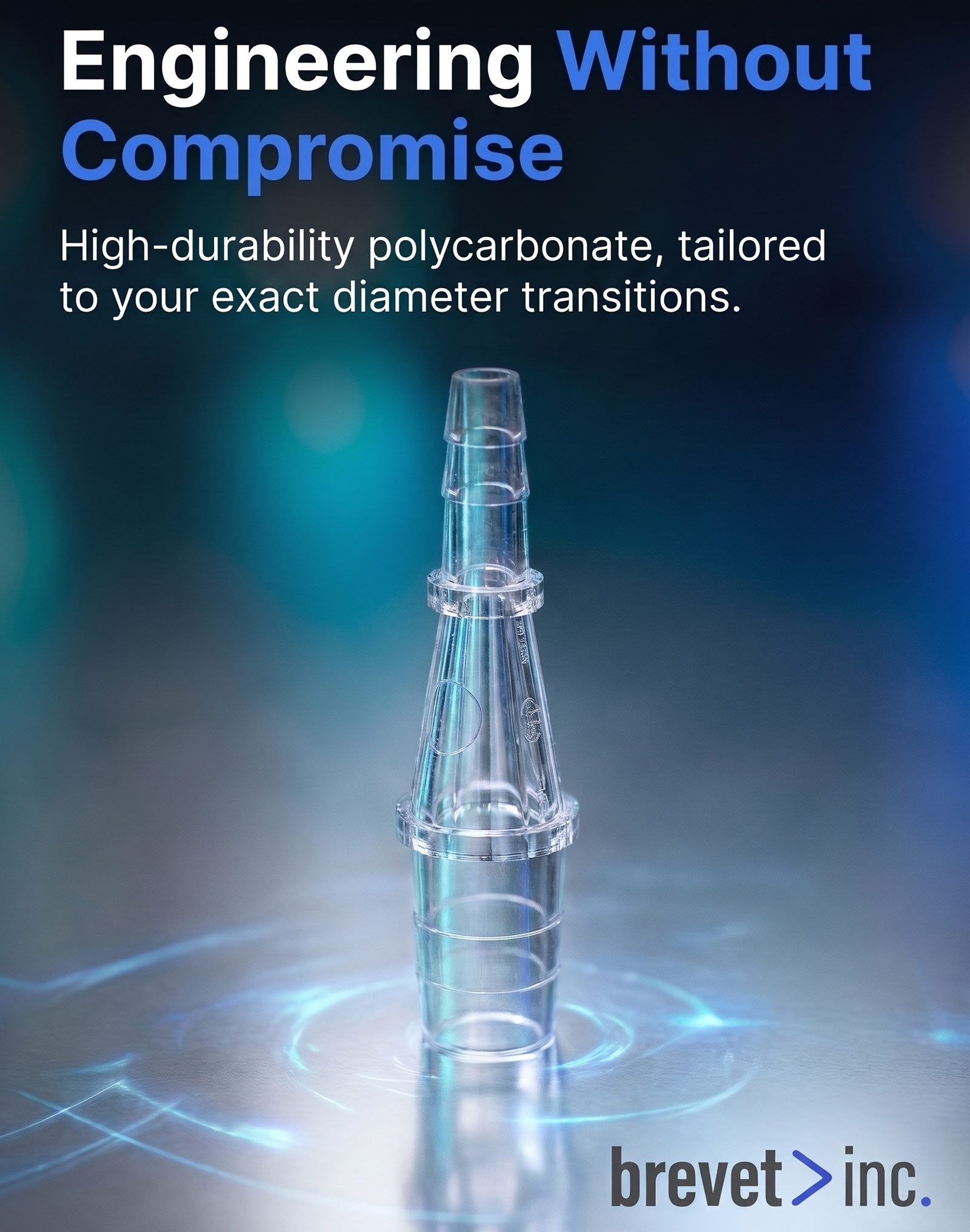
Inside a reducer, geometry matters as much as material. Many standard reducers have flat internal steps or blunt transitions. Fluid doesn’t love those, and flow restriction in fluid pathways is often the result, along with swirling and extra pressure drop.
A purpose-built medical tubing reducer takes a different approach:
Think of it as the difference between a staircase and a ramp.
The biggest worry we hear about custom parts is time. The assumption is that new tooling will stall the whole roadmap.
It doesn’t have to. When you bring a development partner in early, custom fittings can be developed alongside your device housing instead of after it. Prototypes help you check fit and flow early, and tooling work can move in parallel with the rest of your design. The earlier the conversation starts, the more room you have to get it right.
Catalog parts are a great starting point. But if you’re building a proprietary fluid system, there’s a point where the smartest move is to stop designing around the fitting and start designing the fitting around your device.
A tailored part can mean more predictable fluidics, a smaller footprint, and fewer surprises late in the project. At Brevet, we love helping device teams think through custom fluid fittings that fit their design, not the other way around.
If you’re running into flow restriction or fitting headaches in your own device, reach out to the Brevet engineering team. We’d be glad to talk through your design.
