Top Precision Fluid Component Connector Manufacturers for Medical, Biopharma, Dental and more!
Top Precision Fluid Component Connector Manufacturers for Medical, Biopharma, Dental and more!
There’s an old rhythm to manufacturing: design something, build it, test it, find out what’s wrong, and start over. For decades, that cycle was just the cost of doing business. You planned for it, budgeted for it, and hoped the number of iterations stayed manageable.
In high-precision manufacturing — medical devices, dental components, fluid engineering — that rhythm no longer works. The tolerances are too tight, the materials too specialized, and the cost of a failed physical prototype too high. You don’t have the luxury of three rounds of “build and break.”
The answer is to move the breaking into the digital world first.
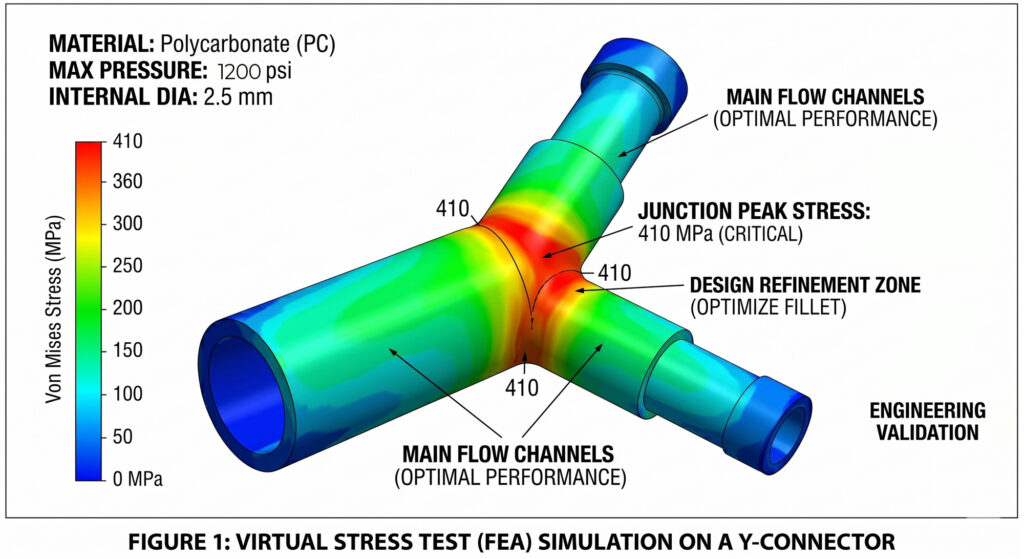
The concept is straightforward even if the technology behind it isn’t: before a component ever gets machined, you build an exact digital version of it and put that version through its paces. Every dimension, every material property, every operating condition — all of it modeled in a high-fidelity virtual environment.
What makes this more than just a fancy rendering is a method called Finite Element Analysis, or FEA. Where traditional engineering relies on static calculations and built-in safety margins, FEA is dynamic. You take the component’s exact geometry, assign it real material properties, and then subject it to realistic operating forces. The software breaks the part into thousands of tiny elements and calculates how stress distributes across every one of them simultaneously.
The result isn’t a guess or an approximation. It’s a map.
Take a Y-connector in a high-pressure fluid system. An FEA simulation will show you precisely where stress concentrates — typically at the junction where the branches meet — and how close those peak stress values are to the material’s limits. It will show you which zones are comfortably within safe thresholds and which ones need attention. You can then adjust the fillet radius at the junction, re-run the simulation in the same afternoon, and confirm the fix before anyone touches a piece of metal.
That same process lets you compare materials side by side in ways that would be prohibitively expensive to test physically. Titanium versus a medical-grade thermoplastic. Standard stainless versus a high-performance alloy. You can model thermal expansion, chemical resistance, fatigue over thousands of operational cycles — all digitally, all before committing to production.
The goal isn’t just to avoid failure. It’s to arrive at the physical prototype with a high degree of certainty that it will perform correctly the first time.
3D modeling’s impact doesn’t stop at engineering validation. It changes how products are understood and used once they leave the facility.
Precision components are inherently difficult to communicate. A 2D technical drawing requires training to interpret, and even then, spatial relationships between parts aren’t always obvious. Photographs of small machined components can be worse — flat, ambiguous, and rarely showing the internal geometry that actually matters.
High-resolution 3D renderings solve this in a way that’s hard to overstate. An exploded view showing exactly how a manifold assembly goes together, rendered in full detail, communicates in seconds what a multi-page technical document might struggle to convey. Assembly steps become intuitive. Maintenance procedures become something users can follow without calling support. The engineering integrity of a component is visible, not just described.
For technical product literature, this matters as much as the engineering itself. A customer who understands how a product works is a customer who uses it correctly and trusts it — and that trust is built the moment they open the documentation.
In competitive markets, development speed is its own form of advantage. A product that reaches the market three months earlier than the alternative doesn’t just capture more revenue — it often captures the customer relationship entirely.
Traditional manufacturing workflows are linear by nature: design, machine, test, identify the problem, redesign, machine again. Each physical iteration eats weeks. A single round of “build and discover” can push a launch date significantly, and by the time you’ve iterated twice, the timeline has slipped in ways that are hard to recover.
Digital-first workflows change the fundamental structure of that process. Iteration in a modeling environment is measured in minutes, not weeks. Adjusting a wall thickness, modifying a thread pitch, or rerouting an internal channel takes an afternoon to design and validate, not a month to prototype and test. Teams can explore multiple design directions in parallel rather than committing to one and hoping it works.
The practical result is a product development cycle that moves roughly 30 percent faster, with fewer surprises at the physical prototype stage. That’s not a marginal improvement — it’s a structural change in how development timelines look.
The shift toward digital-first manufacturing is sometimes framed as a technology story. It’s really a risk story.
Every iteration that happens digitally is an iteration that doesn’t happen in metal, plastic, or time. Every failure mode that’s caught in simulation is a failure mode that doesn’t show up in testing, in the field, or in a customer’s hands. The goal of all this modeling isn’t impressive visuals — it’s engineering certainty. The confidence of knowing that when the physical part is finally made, it will do exactly what it was designed to do.
At Brevet, this is how we approach every component we build. The digital work isn’t preliminary — it’s foundational.
For a closer look at our product configurations and technical capabilities, visit the Kit Hub.
