Top Precision Fluid Component Connector Manufacturers for Medical, Biopharma, Dental and more!
Top Precision Fluid Component Connector Manufacturers for Medical, Biopharma, Dental and more!
The data center industry has a heat problem, and it is not going away quietly. As AI workloads, high-performance computing clusters, and hyperscale facilities push rack densities into megawatt territory, forced-air cooling has simply run out of road. The physics are unforgiving: fans can only move so much heat, and the processors of tomorrow are generating far more of it than yesterday’s infrastructure was ever designed to handle.
Liquid cooling is no longer a niche approach reserved for exotic supercomputers. It is quickly becoming the baseline requirement for any serious high-density deployment, with direct-to-chip systems and secondary fluid distribution networks leading the charge. But bringing liquids into environments where a single hardware failure can cost millions in downtime demands engineering precision that goes well beyond standard industrial plumbing.
Getting the Chemistry Right
The first challenge is chemical compatibility. Cooling fluids range from familiar water-glycol blends to newer single-phase and two-phase dielectric formulations, and each interacts differently with the materials it contacts. Standard industrial plastics that hold up fine in conventional applications can hydrolyze, leach contaminants, or develop stress cracks when exposed to specialized fluids under sustained heat loads over thousands of operating hours.
Brevet is equipped to address this by engineering fluid pathways from high-molecular-weight polycarbonates and advanced engineering thermoplastics, materials with a track record in demanding medical applications, selected for their tensile strength, chemical resistance, and dimensional stability under constant hydrostatic pressure. The geometry of the fluid path should not change, no matter what the system throws at it.
Designing for Tight Spaces
Space is the other major constraint. Server blades in 1U and 2U configurations leave almost no room to maneuver, and cramming standard industrial couplers into those enclosures is a recipe for kinked lines, stressed connector interfaces, and eventual micro-leaks. In a high-density cooling loop, a micro-leak is not a minor inconvenience — it is a potential catastrophe for the hardware it protects.
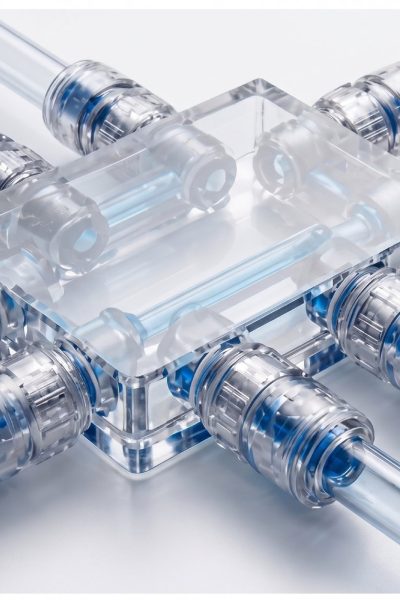
Brevet’s approach to this challenge is to engineer fluid components around the chassis rather than force the chassis to accommodate off-the-shelf parts. Compact 90-degree elbows and multi-port T-junctions route fluid loops flush against enclosure walls, eliminating the awkward angles that create stress points. And because every deployment has its own dimensional quirks, modular injection tooling allows for custom port configurations, outer diameters, and engagement lengths without the cost and delay of entirely new hard tooling, so teams can move quickly without compromising on fit or flow performance.
Keeping It Clean
There is one more variable that rarely gets the attention it deserves: particulate contamination. Microscopic debris or mold flash left inside a connector during manufacturing does not stay put. Under high flow velocities, it breaks free and travels straight to the micro-channel cold plates keeping processors running, restricting flow, causing localized clogging, and setting up the kind of thermal runaway that ends with a very expensive service call.
This is why Brevet applies cleanroom manufacturing standards to components destined for high-density cooling environments. Every connector, adapter, and custom manifold block can be injection molded, inspected, and processed in a certified cleanroom environment, then double-vacuum packaged before it ever reaches an assembly line. It is an approach borrowed directly from medical device manufacturing, and in a modern data center, the stakes are not all that different.
