Top Precision Fluid Component Connector Manufacturers for Medical, Biopharma, Dental and more!
Top Precision Fluid Component Connector Manufacturers for Medical, Biopharma, Dental and more!
The path from a promising R&D prototype to a product on the market is one of the most demanding stretches in any engineering lifecycle. It’s also where some of the best ideas quietly die. Supply chain realities, scalability hurdles, regulatory demands — the list of obstacles is long, and most organizations aren’t built to navigate all of them at once.
For decades, the default approach was to treat R&D and commercial manufacturing as two separate worlds. A design team would spend months perfecting a component under controlled lab conditions, then hand it off to a manufacturing team that often had to rebuild it from scratch to work on a high-volume production line. The result was predictable: friction, inflated costs, and timelines that slipped further and further from the original plan.
Today’s competitive environment doesn’t leave much room for that kind of inefficiency. What the industry needs is a framework that treats development and production as one continuous process, not two separate problems.
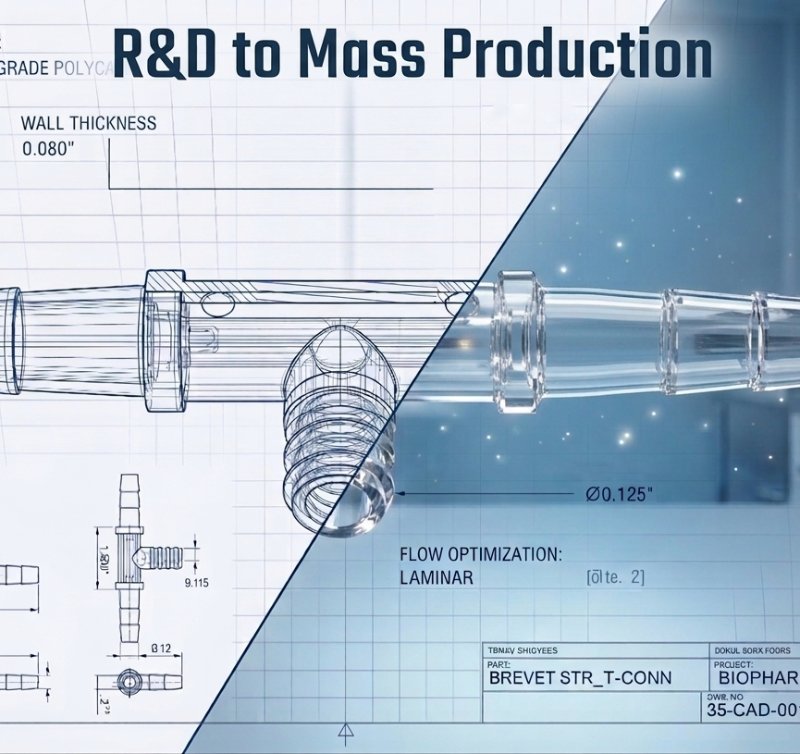
The Scaling Challenge Across High-Stakes Industries
Whether you’re working with medical devices, biomanufacturing systems, or precision industrial hardware, the core scaling challenge tends to look the same. A custom tubing assembly or a specialized fluidic connector might perform flawlessly during a benchtop test with a sample size of ten. Manufacturing that same component by the hundreds of thousands is an entirely different undertaking. It demands absolute repeatability, rigorous quality control, and a materials strategy built for real-world supply chains.
Without a scaling plan baked into the design from the start, projects stall at validation. Tooling costs climb because the original geometry wasn’t compatible with automated assembly. Lead times stretch. Windows close. And by the time the team figures out what went wrong, a competitor has already moved.
The Brevet Advantage: Design for Manufacturability
Brevet’s approach starts with a simple premise: if a product is going to be manufactured at scale, it should be designed with scale in mind from day one. By embedding industrial manufacturing constraints directly into the early R&D process, Brevet eliminates the costly redesign cycles that typically derail commercial launches.
This isn’t just a philosophy. It’s a structural commitment to how the work gets done.
Bridging the Gap: The Brevet Framework
Rather than treating R&D and production as a handoff, Brevet operates as a synchronized ecosystem where design, prototyping, and mass manufacturing coexist under a single engineering umbrella. Three core principles make it work.
Universal Adaptability: Brevet’s infrastructure is built to flex. From custom polymer tubing for pharmaceutical applications to precision multi-lumen profiles for MedTech to robust components for industrial assembly, the production framework scales cleanly across sectors without losing speed or quality.
Agile Prototyping and Rapid Tooling: Moving toward mass production doesn’t have to mean slowing down. Through advanced bridge tooling and modular manufacturing processes, Brevet helps clients scale volume incrementally while continuing to validate design at every stage.
Unified Quality Systems: Regulatory compliance isn’t something that gets bolted on at the end. Validation documentation, material traceability, and testing protocols are integrated from the prototype phase forward, so teams aren’t scrambling to prove readiness when they finally reach scale.
Unlocking Speed to Market
Time-to-market is the number that ultimately matters. A prolonged transition from prototype to production doesn’t just add cost — it hands an advantage to competitors who move faster.
When the engineers who developed your initial prototypes are the same team managing your high-volume production lines, something valuable is preserved. Tribal knowledge stays intact. Setup errors that typically emerge from a handoff never materialize. And scaling becomes a predictable process rather than an anxious one.
Consolidating design expertise, materials science, and large-scale manufacturing capacity into a single partnership compresses timelines in ways that conventional, siloed approaches simply can’t match.
Scaling Without the Disruption
Transitioning from a functional R&D model to full-scale commercial manufacturing doesn’t have to be a high-risk endeavor. With the right partner, it becomes a natural extension of the product development work already underway.
Brevet’s cross-industry expertise and end-to-end capabilities create a predictable, efficient path from early-stage concept to high-yield production. Whether you’re producing low-volume clinical batches or ramping toward automated, high-output lines, Brevet ensures your innovations reach the market quickly, reliably, and without compromise.
