Top Precision Fluid Component Connector Manufacturers for Medical, Biopharma, Dental and more!
Top Precision Fluid Component Connector Manufacturers for Medical, Biopharma, Dental and more!
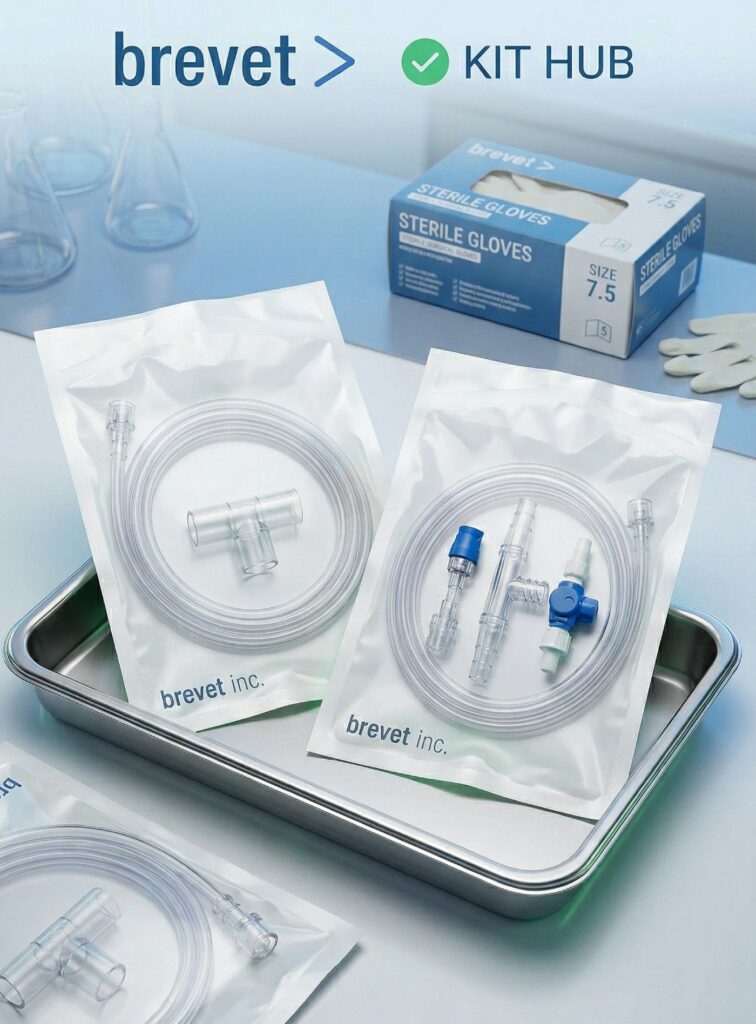
There’s a moment in every ICU or surgical suite that most people never notice. A nurse peels back a sterile wrapper. Connects a line. Confirms the flow. And steps back to focus on the patient.
That moment is quiet, fast, and unremarkable. Yet, it is where lives are quietly held together.
The IV delivery system is arguably medicine’s most humble lifeline. A few feet of tubing, some connectors, a valve or two. But the precision engineered into those components is anything but humble. At Brevet, it’s something we think about everyday.
System integrity over individual parts
Not long ago, the standard approach was to source components from multiple suppliers and assemble them at the point of care. It worked, until it didn’t. Mismatched tolerances. Micro-leaks. Subtle pressure inconsistencies, that are hard to catch and even harder to trace.
The shift toward pre-engineered, pre-assembled kits changed that calculus. When every connector, lumen, and valve is designed as a single system, the tolerance stack-up problem goes away. The clinician opens the packaging and gets a guaranteed flow path, not a puzzle to solve under operating room or intensive care pressure.
Materials that disappear inside the body
The fluid flowing through an IV line isn’t just saline anymore. Biologics, oncology drugs, sensitive protein-based therapies and more. These are compounds with molecular personalities that react to their environment.
The aspect of their reaction means the tubing itself has to be chemically invisible. DEHP-free. REACH and RoHS compliant. Nothing leaching into the fluid path, nothing altering the drug before it reaches the patient. The goal is a material that simply isn’t there, biologically, so to speak. Carrying the medicine without touching it.
Hardware that thinks about the human using it
Speed matters in clinical settings. A nurse setting up an IV line at 2am after a twelve-hour shift doesn’t need a puzzle at all! He or she needs something that clicks into place the first time.
Color-coded connectors. Ergonomic luer locks. Kink-resistant tubing that behaves the same way every time. These aren’t bells and whistles, they are simply cognitive load reducers. The less the hardware demands from the clinician and professional, the more attention they can give to the patient under care.
Good engineering disappears into the background. And this is the point.
Custom kits, because patients aren’t standard
A pediatric patient isn’t a smaller adult. An oncology infusion isn’t a saline drip. Specialized imaging procedures have their own requirements entirely. The idea that a single kit design could serve all of these contexts never made much sense.
Custom kit engineering means the right components are there, and the wrong ones are not. Fewer unnecessary connections. Faster setup. Less opportunity for contamination between assembly and use. In a field where seconds and sterility both matter tremendously, that specificity adds up completely.
The quiet work behind every line
At Brevet, we’re not just building components, we’re building the confidence that lets clinicians focus on what only they can do.
Fluid dynamics is physics, but the trust that the hardware will perform exactly as intended, every single time, without a second thought, is something else. That’s the part we’re responsible for.
The smallest details in IV delivery have always mattered more than they appear. We’re just here to make sure they’re right.
